Wednesday, November 28, 2012

Wordles From Chapter VI in the Scarlet Letter

See if we can pick out differences in Pearl's construction throughout Chapter VI.

First Half

Wordle: Scarlet Letter Chapter VI Paragraphs 1-5


Second Half


Wordle: Scarlet Letter Chapter VI second half


Tuesday, July 17, 2012

Animations or Images

   Frankly, I don't see the difference in most learning applications between using an animation over an image. An image can be so rich, so multifaceted, so ambiguous, that through proper manipulation of the form of an image, or by using more than one image, great learning can occur.
    Consider one of my topic earlier, Google Body or Google Earth.  These are basically just images, but they are three dimensional and able to be manipulated by the viewer.  I think viewer interactivity is a better educational litmus test than if the picture actually moves.  
   Lots of educational writers use the term "static" image, but isn't a flash video that replays over and over again just as starchy and annoying.  I think effective visual representations should be able to be played with, adjusted, allowing the reader a way to connect and personalize what he's seeing.  We should be judging our visualizations by the user experience, not just what it "looks like."

Monday, July 9, 2012

A good grammar video...does such a thing exist?

   So I went on the hunt for some good grammar videos.  I'm sure that's a sentence most people write on a daily basis.  What I found were lots of grammar videos but nothing good.  Lots of people in front of the whiteboard, lots of boring stuff.  Grammar is boring to begin with; couple that with the low quality of most web videos . . . I couldn't finish the stuff.  How would my students?

Friday, June 15, 2012

Grammar Girl

    Grammar Girl  is one of my favorite web sites for grammar.  It's run by a woman named Mignon Fogarty.  She does a great job of responding to real grammar issues and coming up with responses to people's questions.  She has a lot of articles, but she does some great podcasts as well.
     Here's a great podcast on a common grammar issue, affect vs. effect.    Ms. Fogarty does a nice job using a really simple illustration and pneumonic to get her point across.  She includes a voicemail in the beginning of the podcast to identify the problem.  The whole podcast is a manageable 5 minutes.
     There's a defined goal here, a simple and clear message, all in a mangeable format.

Tuesday, June 12, 2012

Visualizations--Good and Bad

   Images seem to be one of the ubiquitous aspects of the internet.  A major website like SI.com will have hundreds of individual links.  Take a minute and really look at the image below:


   You've got box scores, you've got stories, blogs, front page articles, you have subscriptions, links to every major sport and other topics.  You can go from this page to almost any piece of information in the sports world.  One click.  That's no accident.  
    We are now used to this kind of visual delivery for content.  In the last few years, the internet has spawned the infographic.  A long, visual representation of ideas with text.  You have to scroll through these graphics just as you would a news articles, and they contain text.  What's key here though is how carefully they use color and simple images to get their ideas across.  Here's an interesting example:


Media Consolidation Infographic
Source: Frugal dad

     Some sites are not elegantly organized or barely use any images.  Our school formerly used groupfusion as a webportal.  We had pages that looked like the following:
Groupfusion... Bleh...
     Groupfusion was functional for our school.  You could have announcements and files, links and calendar updates.  But this wasn't much more than a glorified filing cabinet for resources.  There was no real way of prioritizing information by date or importance.  It was hard to group links and files together in a single folder.  But there wasn't the kind of graphical interface that makes other webportals effective.  The kids knew that when they were on Groupfusion, you were doing SCHOOL stuff.  And not in a good way.


Thursday, May 31, 2012

How is a whale like a web-page?

   Students like linear texts.  Teachers like linear texts.  There is a reason why textbooks have nice bold vocabulary words, questions for comprehension, headings, and all that jazz.  It's possible to open a textbook, gather information, but not actually READ anything.  The kids are comfortable with this; these texts allow them to get through lots of reading, do well on their AP Bio exam, etc.

    But there's something to a text that is creative, non-linear, and different.  When students read Moby-Dick for the first time, it's incredibly disorienting.  Chapters spring from everywhere.  They have to work to understand the connections between chapters, that, on the surface, appear so different.  There is a lot of work, but the ultimate effect is masterpiece.

    Such is the case with hypertext.  Those that say that hypertext is a liability compared to linear text, that it puts increased cognitive demands on the learner, totally miss the point.


Wednesday, May 30, 2012

Hypermedia

    In 1996, D.H. Jonassen wrote a piece about the power and possible applications for Hypermedia in the classroom.
    Now, hypermedia is basically mainstream.  Students and teachers, along with almost everyone connected to the internet, uses the world wide web on a daily basis.  We are used to having an incredible array of interconnected knowledge at our fingertips.
The city of Dresden
     What has happened recently is for some companies, especially Google, to make these hypertext incredibly visually and information rich, and for them to resemble real life sights.  I'd like to give a few examples of Google applications that our beautiful, content rich applications.
     Google Earth is a wonderfully ambitious platform.  It attempts to document the world as it actually is, both in 2 and 3 dimensions.  It then superimposes information: building names, stores, streets, natural landmarks, on top of the image.  Google Earth has even developed ways for students to create "tours" and move around the world.  Students can create their own labels, or "nodes," of information, tagged at appropriate places.  Even more recently, Google Earth has allowed users to create fictional or historical buildings and cities.
     Part of what makes Google Earth such an effective and widely used example of hypermedia is that its mission and flexibility is so broad.  It really attempts to map the entire earth.  It then lets the user utilize that map and tag information that he or she deems appropriate.  You can use the application for geography, literature, art, history, or science.  Because it is so successful in creating an accurate representation of the world, using it is almost like not looking at a computer at all, but playing with reality.
Body Browser from Google
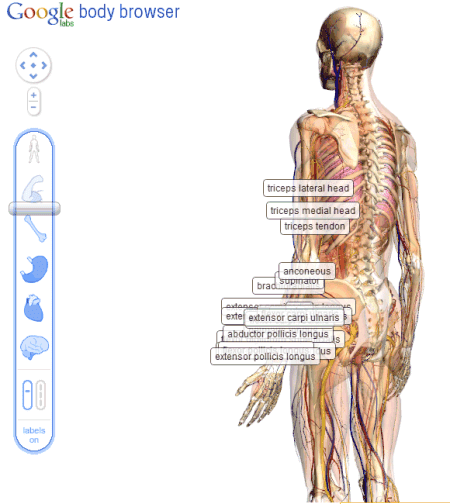
    Google BodyBrowser is a take off of Google Earth, but with the human body.  Science teachers used to have diagrams, skeletons, and textbooks in their class.  Now the skeleton is the textbook.  The student can look at skeletons, organs, different systems, or any combination.  The resource is fully searchable.
    Adding information to a realistic, but flexible image is one of the great attributes of Google Earth and BodyBrowser.  Students can see how different organs and systems interact within the human body, but they can also explore, almost as if they are going into a cadaver, but anything they click on can bring more information to the screen.  It would be a very powerful tool for biology students to go and explore, report back their findings, and then to discuss the disagreements or issues that students found.  BodyBrowser is complete discovery, complete freedom of information within the human body.
       There are other ways to give students a basic blank canvas, and ask them to create their own content and structure on top of it.  Inspiration Maps is an example of a solid product that allows students to use Ipads and the like to create their own maps.
       With Inspiration Maps one could create a pretty similar product to what Jonassen describes in the second half of his piece.  However, it's important to note that this really is a blank canvas.  The students have freedom to create their own "hyper" information system, but they would have to create everything themselves.  I believe the power of Google Earth and Google BodyBrowser, is that they create a visual template for the students to explore and then add to them.
        I'm not sure that in 1996 we could invision that a company would map out the entire Earth or human body.  But now we have enormous resources for our kids to use and then augment to meet their learning needs and to show their understanding of a subject.
   

Sunday, May 20, 2012

Digital Natives--Digital Immigrants

     Saying something new about Prensky's "Digital Natives Digital Immigrants" is now almost impossible.  I'm not sure if I know of any piece of writing that has produced more discussion or agreement.  Prensky spawned cliches and forced educators to take sides, to declare themselves.

     So what does my digital passport read?  I'm 27, so I was growing up when the promise of the personal computer was beginning to develop.  I remember tying up my parents phone line on AOL, playing the earliest version of the Oregon Trail, and downloading programs to hack Instant Messenger.  I was always more comfortable working with text on the screen, typing rather than writing.  Organizing my thoughts, files, and life, always seemed easier on the computer.

Wednesday, March 21, 2012

Cetology Project

Cetology Project--70 points

Melville includes about 20 chapters that many readers call the “Cetology” chapters. Cetology is a fancy word for the scientific study of the whale. The main questions we seek to answer while we read and study this chapter is:

Why does Melville include these sections? What does science have to teach us about literature and vice versa?

Step 1: You will be assigned one of these chapters:

-Squid (Whalefood)
-Brit (Ocean biology vs. Land biology)
-The Whiteness of the Whale (albinoism in science and different cultures)
-The Sperm Whale's Head--Contrasted View
-The Right Whale's Head--Contrasted View
-The Battering Ram (forehead)
-The Great Heidelburg Tun (a compartment in the whale's skull)
-The Prairie (head)
-The Blanket (skin)
-The Nut (brain)
-The Fountain (the spout)
-The Tail
-Ambergris
-The Cassock (the reproductive organs)
-A Measurement of the Whale's skeleton (the skeleton)
-The Fossil Whale (the decomposition of the whale)


Step 2: Read
Read the biology report.
Take notes on the specific features of the whale and why they are there. Make an outline about the most important facts in the report.

Read your chapter
Takes notes on the specific scientific details on the whale. Underline those passages. Keep in mind: why are these facts being included?


Step 3: Think and write
Write a short essay that answers the following questions. Be sure to cite examples from the text AND THE BIOLOGY REPORT in your answer.
  1. What scientific concepts or facts does Melville allude to? What, if anything, does he fail to mention? What does he get wrong? What does he get right?
  2. Each part of the whale is a symbol that tells part of the whale’s story. What is the figurative significance of your assigned part of the whale? How do the scientific facts add to figurative meaning?
  3. What is the ultimate effect of the scientific information in the book?


Rubric: (70 points)

10 points: Introduction that clearly mentions the main ideas in each body paragraph. The introduction is as specific as possible.

15 points: 1st paragraph
Clear topic sentence that specifically mentions all the main ideas in the paragraph
Use of direct quotations from the text
Close readings, direct discussin of the quotations to link back to main ideas. The 8th grade biology report is quoted or referred to DIRECTLY. Additional scientific sources may be quoted.

15 points: 2nd paragraph
-Clear topic sentence that specifically mentions all the main ideas in the paragraph
-Use of direct quotations from the text
-Close readings, direct discussin of the quotations to link back to main ideas. Figurative significance has quotes to support close readings. Those ideas are linked back to specifics in the 1st paragraph regarding scientific facts.

15 points: 3rd paragraph
-Clear topic sentence that specifically mentions all the main ideas in the paragraph.
-A discussion that links back to previous ideas (in the 1st and 2nd paragraph) and draws larger conclusions about the effect on the reader.

15 points: Formatting:
Sentence strucutre, quote citations, introducing quotes, punctuation, word use, missing words, run-on sentences, etc...

Thursday, February 23, 2012

Moby-Dick Allegory Assignment

Allegory Assignment

Your assignment is to write a short essay explaining the connections between Captain Ahab and a historical figure. You can explain the allegory as a piece of "historical allegory" or "portentous allegory."

If you're interested in historical allegory, you need to connect Captain Ahab to a figure from 1830-1851. There are specific people that Melville was thinking about, reading about, hearing, and seeing, when he was constructing Ahab. You need to connect Ahab to one of these figures.

If you're interested in portentous allegory you need to connect Captain Ahab to a real person from 1851-present day. Part of what makes Melville great is that he anticipates leaders, movements, and issues that are well before his time.

Regardless of your time period your essay needs to accomplish the following:
-A 2-3 sentence introduction that explains the connection between the two figures. (Thesis).
-A paragraph outlining specific traits in the historical figure with at least 3 cited sources.
-A paragraph tracing the same traits in Ahab that incorporates close reading from at least 3 quotes from the text.
-A short conclusion

All in all, we're looking at 600-800 words here. Be creative withe the figures you pick, and be specific with the traits that you are identifying. "Strong leader" is not going to cut it.

Rubric:
Intro: 10 points
Accurate thesis sentence that identifies the similar traits between the two figures.
1st Paragraph: 20 points
10 points: Multiple traits identified by a topic sentence, accurate use of citations, 3 sources.
10 points: In depth close reading looking at details from the selection. Avoiding summary.
2nd Paragraph: 20 points
10 points: Multiple traits identified by a topic sentence, accurate use of citations, 3 quotes from Moby-Dick.
10 points: In depth close reading looking at details from the selection. Avoiding summary.
Formatting: 10 points
Paragraph use, sentence structure, specific language, punctuation, cliches, missing words, etc...

Total: 60 points

Wednesday, February 22, 2012

Allegory in Moby-Dick


Allegory is like symbolism--but better 

The power of allegory in Moby-Dick is the fact that Melville uses allegory on many different levels, sometimes simultaneously.  Here are a few examples:

Specific Allegory
The journey of the Pequod mirrors the journey of the United states in the pre-Civil War era
This is an example of fairly specific, contemporary (during Melville's time period) allegory.  Animal Farm would be an example of this use of allegory
    -Politically, racially, socially, and economically, Melville comments on the country he sees in 1851.  He creates characters to represent 
    large ideas.  (Pay attention to the "Knights and Squires" chapter for this.)
    -Specific leaders from the 19th century seem to be reflected in the book, especially in Ahab.  (Hickory harpoon...old hickory)
      -John C. Calhoun, Andrew Jackson religious leaders, abolitionists, secessionists  
    -Moby-Dick, the object of the ship's obsession, has been connected to many different American pursuits int he 19th century.

Moral Allegory
The novel, in some ways, has moral messages and connections that has nothing to do with America, and has everything to do with being a human being and living in a moral way
This is an example of more general, more timeless, allegory which tries to impart a moral message. Aesop's Fable's would be an example of this kind of allegory.
    -The book resembles a moral, religious fable, such as the story of Sodom and Gomorrah or other "Jeremiads." 
    -The central conflict between Ahab and the whale represents the conflict all men have with God

Portentous Allegory
Moby-Dick seems to predict the political actions and the rise and fall of specific leaders, making it a more specific allegory that transcends time and space.  
    -Captain Ahab has been read as figures separated by hundreds of years and thousands of miles.  
        -Adolf Hitler, Mussolini, Stalin
        -Huey Long (Former Governor of Louisiana quoted as saying, "Of course we'll have fascism in America, but we will call it 
        democracy!"
        -George Bush
    -The more you look for Captain Ahab, the more he seems to appear, especially in American culture


Thursday, February 2, 2012

Whaling Webquest Group Activity

Day 1--Gather
Form groups
1. whale ships--tools, ship layout, dimensions, tool functions
2. whaling people--captains, crew, social dynamics, stories, examples of figures, racial/economic makeup
3. whale creatures--whales, behavior, size, population size, strategies for hunting, products made from whales
4. whaling procedures--hunting method, boiling down, stowing; pre 19th century whaling
Collect facts--with each member of the group, find as much information you can an copy and paste it into a Google Doc shared to each group member and myself.
You’re essentially taking notes.
You will need to CITE YOUR SOURCES OF INFORMATION. So note where your stuff comes from.

Please draw from the following websites FIRST:
Articles:
Melville:

Your notes will be due on the designated day.

Wednesday, February 1, 2012

1st Moby-Dick Blogging Assignment: Loomings

Your assignment is to create a novel in the same style and with a similar structure of moby-dick.

So in general, you need to write with a narrator in the first person who pursues a goal through a journey.  (Which is pretty much every story ever.)


But for your first chapter you should identify some key features of your story and your narrator:

-His or her goal

-The nature of the journey

     -For Melville, the nature of the journey has a larger significance, and works with the goal.

-Key elements of the character's personality


You can try to make the structure and feel of your novel very similar to MD or you can go off on your own tangent.  As long as you meet the qualifications above, you are good. 


Topically, you can choose whatever you want.  Make the assignment your own. 


You can always go back and tweak your earlier chapters if you want to make some changes along the way. 


Somewhere around 500 words.


And, of course, your piece should begin with "Call me ...."


You are going to be graded on the following criteria (30 points):

    (10) Meet the structural qualifications for the post listed above

     (10) Effective and engaging story

     (10) Writing mechanics, attention to detail, overall effort

Sunday, December 18, 2011

Speak Editorial Assignment


Speak Editorial Assignment   75 points
    
    Your major writing assignment for Speak is partially a reaction to Speak and partially a persuasive essay reflecting on the world you live in.  
      Your goal is to create an editorial.  An editorial, usually written by a member of the newspaper staff or a highly qualified writer, analyzes the world around them, pushes for a specific kind of change, or supports a specific person, action, or group.  
Almost every paper has an editorial page.  Here is the Washington Post’s , New York Post’s, and The Guardian’s.  They often debate complex national matters.  Sometimes papers discuss local matters.  A type of editorial, a great tradition in American democracy, is the letter to the editor.  Here are the letter to the editor pages for The Daily Record and The Star Ledger.  Use all of these sources for context and format.  
Specifically though, we are looking at our own communities in a season of change and hope.  I would like you to look specifically at the world around you.  At times the structure of this world creates pain for the people in it and not necessarily because of ill-will.  I want you to identify that structure, or mechanism, or habit, argue why its a problem, and look for a solution.  Don’t worry if your solution is as simple and “wishy-washy” as something like awareness or sensitivity (obviously, the more definable the solution the better, but I’m not asking for a step-by-step plan on how to end world hunger).  
Your focus may be as wide as our overall culture, it might be as specific as something you see in your group of friends, or your school, or your town.  You may be a part of the problem or part of the solution--it doesn’t matter.  
Keep in mind, these will be read by lots of people.  You don’t want to say anything that might be taken personally.  Avoid mentioning specific people.  Also avoid making wide generalities, as they are rarely helpful.  (”All athletes do this.”  “All rich kids do that.”)
        The best two pieces will be published in the Notre Dame Academy school newspaper.  
Your piece must be between 300 and 500 words.  

You will be graded on:
Clearly stating the problem your piece is trying to confront: 10 points
Developing your main idea with support throughout the body paragraphs: 10 points
Having a cleanly organized piece with good paragraph use: 20 points
The effectiveness of your argument: 20 points
The writing style and grammar of your argument: 15 points

Monday, November 21, 2011

Rhetorical Strategies and Literary Terms


Rhetorical Devices Cheat Sheet


Devices found in every piece: Devices found in most pieces:
Punctuation Imagery
Diction Metaphor
Mood Alliteration, Assonance, Consonance
Point of View Parallelism
Setting
Tone


Figurative Language--Means something other than what it says (You have to figure it out) Imagery--Relating to one of the five senses.
I walked outside and the cool grass brushed against my bair feet.   Metaphor--Comparison of two unlike things. (Make sure that the comparison is not actually real. For instance, I don't actually have an iron heart. If the line said Mr. Flynn has a "beating heart," that would just be a description.)
Mr. Flynn has an iron heart. Simile--Comparison of two unlike things using “like” or “as”
I run like an antelope. Personification--Giving objects human characteristics.
The sky looked angry. Allusion--A reference to something outside the text
Call me Ishmael.  (Ishmael is a Biblical name) Symbol--When an object has a meaning larger than itself

Monday, November 14, 2011

Frederick Douglass Project

Frederick Douglass Project

Create a prezi in which you present the following:
(Prezi.com) ← Mainsite
(prezi.com/learn) ← Teach yourself Prezi
Example

3 arguments that Douglass makes against Slavery.

-These should be factual, in your own words, type of statements. For instance, if I were doing this for Into the Wild and nature, I might say that “Chris McCandless states that nature is a place where man can challenge himself and bring out the truest version of his humanity.”
-They must be backed up BY QUOTING THE TEXT
-The text must be close read, and unpacked. In the close reading (2-3 sentences) there should be an explanation of why the text leads you to believe that Douglass is making the argument you have previously identified.

3 different “rhetorical strategies” that Douglass employs to deliver this argument
(Note, the strategies do not have to match with the arguments.)

-It’s one thing to state an argument, it’s another thing entirely to sway others to your point of view. To do so takes craft and skill as a writer. Here is a list from the almighty AP board:
Diction, Syntax, Imagery, Tone, Selection of detail, Irony, Satire, Point of View, Structure, Humor, Sarcasm, Analogy, Soliloquy, Persuasion, Oxymoron, Onomatopoeia, Parallel Structure, Contrast, Comparison, Metaphor, Simile, Personification, Symbolism, Assonance, Alliteration, Paradox, Anecdote, Attitude, Juxtaposition, Hyperbole, Exaggeration, Repetition, Punctuation, Quotations, Foreshadowing, Characterization, Flashback, Rhetorical questioning
(We’ve already gone over a number of these strategies both as vocabulary and within our own close reading work.)

-However, you might also think about rhetorical strategies in a more general way and come up with your own concepts. For instance, you might claim that Jon Krakauer uses “mystery” when he presents McCandless as an anonymous hitchiker on the side of the road sporting an odd nickname. You might build on a term from above and discuss how Abraham Lincoln uses “Religious Allusions” when he writes about “the better angels of our nature” in the First Inaugural Address.

-Again, once you state the rhetorical strategies you MUST QUOTE THE TEXT you’re referrring to.

-Additionally, you must close read the text (2-3 sentences) and explain the rhetorical strategy and why the strategy is effective.

2 different myths that Douglass attempts to dispel with his Autobiography
-Be sure to include the myth and how Douglass attempts to dispel it.
-As always, you need a statement, a textual example, and a close reading.

2 different examples of emotional appeals that Douglass makes to the reader
-Not everything that Douglass tries to do is rational. At times he tries to make the reader FEEL something.
-Explain what he makes us feel and how he gets the feeling across.
-As always, quote the text and analyze it.


Grading: 100 points

10 points for each argument, rhetorical, myth, or emotional appeal strategy
-Proper label for the argument and rhetorical strategy (2 points)
-Textual evidence (2 points)
-Close reading that refers back to the quotations and the particular argument and strategy (5 points.
The key to this project is to explain clearly HOW Douglass gets his point across. This is where rhetorical analysis and close reading comes in.
-Perfect grammar (1 point)

Tuesday, October 18, 2011

ITW Blogging Assignment

ITW Blogging Assignment--Non-fiction Reporting 50 points
Due Friday October 28th at 11:59 PM

One of the most compelling parts of the novel is how Jon Krakauer builds a non-fictional character using a number of different strategies.
   
As we’re learning in our McCandless Presentation Projects, Krakauer uses setting, actions, writings, influences, effects, different points of view, and family influences in an attempt to explain why Chris does what he does. The effect is a multifacated, intriguing mosaic--a deep picture of a man.  
   
In an attempt to understand this style, I would like you to copy it.  
   
Pick a real person. It can be any person, living or dead, and describe him or her in a compelling way using at least two of the above characterization strategies. If you want to use a characterization strategy that Krakauer doesn’t use, that’s fine, but you should have at least two different ways of “framing” your subject.  
    
You are going to have to do some research. Not academic research, gathering facts in an effort to frame your idea.      
    
This post should be a little bit longer--around 500 words at a minimum. It will also be given a slightly larger grading weight. 50 points.

Grading:
30 Points--Graded as a normal blog post
20 points--How effective are the characterization strategies? Are there two distinct ways of framing the subject? Do the strategies work together or is the piece disjointed and jumbled? At the end of the day, how effective is the piece at presenting the subject?